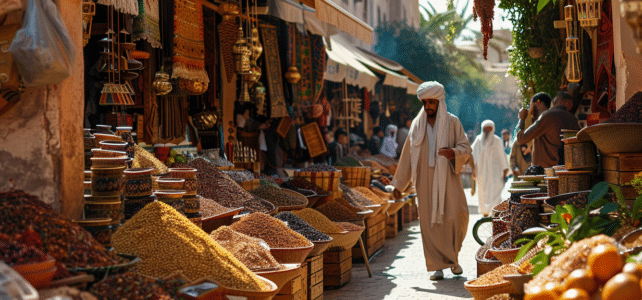
The Maghreb dialect, rich in colorful expressions, is a fertile ground for exploring the popular wisdom passed down from generation to generation. These often figurative phrases, sometimes enigmatic to the untrained ear, constitute an essential part of the cultural identity of the Maghreb. They reveal the customs, history, and values of the peoples of Algeria, Tunisia, and Morocco. Decoding these idioms allows not only for grasping the literal meaning of the words but also for understanding the social contexts and subtleties associated with them, thus providing an authentic insight into Maghrebian mindsets and ways of life.
Maghreb expressions in everyday French: between identity and cultural sharing
You may also like : Identifying Clutch Problems in an Automatic Car: Symptoms and Solutions
Popular expressions from the Maghreb dialect and their integration into everyday French reflect a complex sociolinguistic reality. Major cities in France, such as Paris, Lyon, or Marseille, regularly resonate with the sounds of Arabic, a language that, over the waves of migration, has carved its way into the lexicon of many French people. Words like ‘wallah’ and ‘salam’ have now crossed the barriers of ethnolinguistics to be incorporated into everyday speech, including among young Muslim French people who use them to assert their cultural identity.
Arabized French, this variety of French that has been enriched through cultural contacts, manifests itself through notable linguistic interference. The expression ‘wallah lahdime’, literally ‘I swear by God’, is used with a frequency that exceeds just Arabic speakers. This phenomenon attests to the permeability of languages and the ease with which lexical elements can migrate from one idiom to another, reflecting the dynamics of a multicultural society.
See also : Tips and tricks to support parents in raising their children
Consider the sociolinguistic aspects that underlie the use of these expressions. Speakers of Arabized French, often from Maghreb immigration, do not merely transpose terms; they also convey concepts, social representations, and values intrinsic to their linguistic heritage. The adoption of these terms by non-Arabic speakers, on the other hand, can be seen as a sign of recognition, even appropriation, of a shared cultural wealth, once again demonstrating the vital role of language as a vector of integration and social cohesion.

Understanding and using expressions from the Maghreb dialect: practical guide
The influence of Arabic on the French language is established not only in the adoption of terms but also in syntactic structures and verb valency. Arabized French is characterized by modifications that reflect this linguistic interaction; for example, verb valency can be altered, leading to a change in how French verbs manage their complements. A transitive verb may acquire an intransitive use under the influence of Arabic, thereby modifying the established linguistic code.
The works of Frans van Coetsem, a renowned linguist, shed light on the role of linguistic contact in the diachronic change of languages. Verbs in Arabized French concretely illustrate how language evolves under the effect of this contact. Understanding these mechanisms is essential for speakers wishing to master the subtleties of this linguistic blend. The appropriation of expressions from the Maghreb dialect therefore requires particular attention to these syntactic and semantic nuances.
In the current context of globalization and intercultural travel, mastering these expressions proves to be a valuable asset. Verlan, a well-known linguistic phenomenon in French, finds an echo in the use of Arabic expressions, where the inversion of syllables or sounds produces a similar coding effect. For French speakers, the use of these Maghreb expressions enriches the linguistic repertoire and facilitates intercultural dialogue. Follow these leads, observe the uses in everyday discourse, and integrate these expressions judiciously to enhance your practice of the French language.